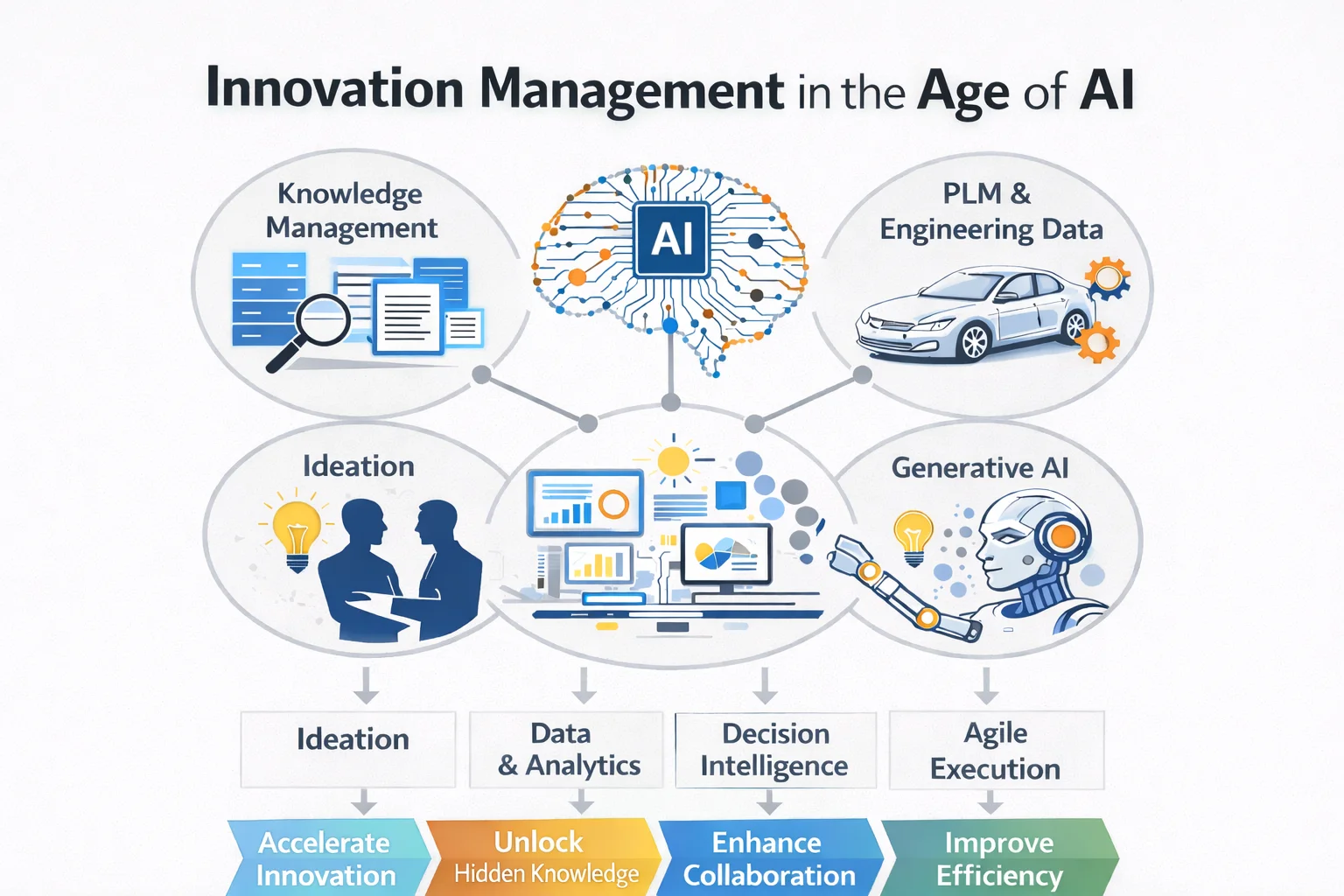
Innovation has always been central to business success, but in today’s digital-first economy, speed and intelligence define competitiveness. The starting point of innovation remains ideation yet ideation is only as strong as the knowledge that fuels it.
Knowledge resides across people, documents, systems, and historical product data. When this knowledge is combined with creativity and enabled by Artificial Intelligence (AI), organizations unlock a new level of innovation capability. Modern enterprises now recognize that AI-powered knowledge management is no longer optional, it is a critical component of the innovation lifecycle.
Innovation today depends on the intelligent use of data, information, and contextual knowledge, enhanced through AI and analytics. At the same time, organizations face growing challenges: workforce transitions, loss of tacit knowledge, increasing product complexity, and shrinking innovation cycles. AI offers a powerful way to bridge these gaps.
Innovation in a Rapidly Evolving Digital Economy
Global and regional economies continue to experience disruption from supply chain volatility and regulatory changes to rapid advances in digital technologies. In this environment, innovation is no longer a periodic initiative it must be continuous, scalable, and repeatable.
Organizations are expected to:
Traditional innovation models, heavily dependent on individual expertise and manual processes, struggle to keep up. The challenge is no longer the lack of ideas it is the inability to access and reuse existing knowledge efficiently.
The Growing Knowledge Gap and How AI Helps Bridge It
Historically, organizational knowledge lived in people’s minds and scattered documents. Today, much of that knowledge is locked inside:
As experienced professionals retire or move on, organizations risk losing critical tacit knowledge. This is where AI comes to help.
AI technologies especially Generative AI and Machine Learning can:
Instead of searching manually, teams can ask questions and get answers from their own engineering knowledge base.
From Engineering Data to Engineering Intelligence
Industries such as automotive, industrial manufacturing, consumer goods, and electronics are increasingly driven by:
Yet studies consistently show that engineers still spend a significant amount of time searching for information, recreating designs, or correcting avoidable errors.
AI-enabled Engineering Knowledge Management (EKM) changes this paradigm by:
The result is a shift from data-driven engineering to intelligence-driven engineering.
AI as an Enabler of Systematic Innovation
AI does not replace human creativity it amplifies it. And its impact is measurable: research from Deloitte found that 84% of organizations investing in AI and GenAI report positive ROI, especially in data management and insights-driven processes.
Globally, 78% of organizations now use AI in at least one business function, up sharply from 55% just a year earlier, indicating rapid mainstream adoption rather than experimental use. This shift is part of a broader digital transformation trend, with global digital transformation spending expected to reach $3.9 trillion by 2027 as businesses invest heavily in AI, cloud, and analytics to stay competitive.
By embedding AI into innovation and PLM ecosystems, organizations can:
When AI is integrated with PLM platforms and digital engineering systems, innovation becomes structured, repeatable, and scalable rather than dependent on isolated brilliance.
The Competitive Edge of AI and Knowledge Integration
AI-driven innovation management is not just a future vision it is a present-day strategic imperative. Analysts find that 59% of companies believe AI adoption will be highly relevant to their business in the next two years, highlighting near-term industry priorities.
Furthermore, as organizations mature with AI, the benefits extend beyond automation:
When AI is integrated with PLM platforms such as ARAS, 3DEXPERIENCE, innovation shifts from reactive problem-solving to proactive, insight-led execution.
The Way Forward: Intelligent Innovation Platforms
The future of innovation lies in platforms that combine:
Together, these capabilities help organizations move from reactive problem-solving to proactive innovation planning.
AI-powered systems ensure that the right knowledge reaches the right person at the right time whether during concept design, cost estimation, supplier collaboration, or change management.
We provide custom software development, cloud solutions, IT infrastructure setup, system integration, and ongoing tech support.
It depends on the scope. Small projects may take 2–4 weeks, while larger systems can take 2–3 months or more.
Yes, we offer maintenance and support packages to keep your system secure, updated, and running smoothly.
Absolutely. Every solution we deliver is tailored specifically to each client’s business goals and operations.
We’ve worked with clients in retail, healthcare, logistics, finance, and more.
Simply contact us through our website or email, and we’ll schedule a free consultation to understand your needs.

At BWC Labs, our mission is to empower businesses with cutting-edge technology solutions. We believe in the transformative power of innovation and are committed to helping our clients achieve their goals.