If we look at PLM and engineering environments practically, there are clear areas where AI can improve productivity without interfering with
core design ownership.
Some realistic use cases include:
Many engineers today spend a significant amount of time:
These are not creative tasks. These are efficiency tasks.
AI can reduce that friction.
For AI to be useful in engineering, it must have access to enterprise data.
That raises serious questions:
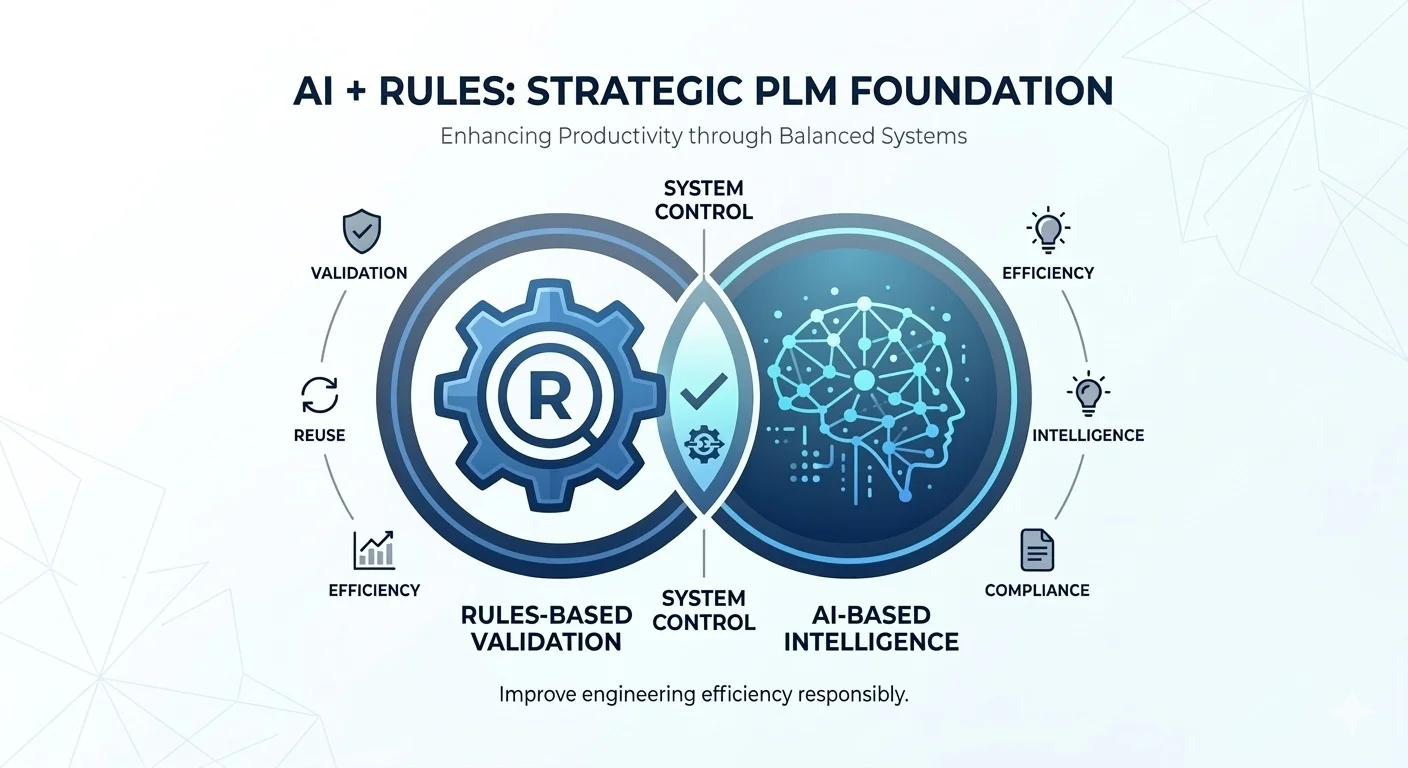
Rules provide structure and control.
AI provides contextual intelligence.
This balance is important in R&D.
For AI to be useful in engineering, it must have access to enterprise data.
That raises serious questions:
AI must be trained on organizational data – but within controlled environments.
Without proper governance and security frameworks, AI adoption will stall.
AI can help improve efficiency in areas like:
These are practical improvements.
But creativity, innovation, and core design decisions must stay with engineers.
AI should assist. Not replace.
To reach that stage, organizations need:
AI tools cannot compensate for poor data quality.
If data maturity is low, AI maturity will also remain low.
Currently, AI in R&D and Engineering is still in early stages of maturity. Many organizations are experimenting. Few have scaled it successfully.
AI in Engineering and PLM is not a switch that can be turned on. It is a journey. The real objective should not be “using AI.”
It should be improving engineering efficiency responsibly.
AI can help:
But it must be implemented carefully, securely, and with engineering ownership intact.
AI maturity in R&D will grow – but only if built on strong data foundations.
 Rahul Deshpande
He is the CEO & Founder of BrainWave Consulting with over 30+ years of industry experience in PLM, digital engineering, and digital transformation.
We provide custom software development, cloud solutions, IT infrastructure setup, system integration, and ongoing tech support.
It depends on the scope. Small projects may take 2–4 weeks, while larger systems can take 2–3 months or more.
Yes, we offer maintenance and support packages to keep your system secure, updated, and running smoothly.
Absolutely. Every solution we deliver is tailored specifically to each client’s business goals and operations.
We’ve worked with clients in retail, healthcare, logistics, finance, and more.
Simply contact us through our website or email, and we’ll schedule a free consultation to understand your needs.
At BrainWave (BWC), our mission is to empower businesses with cutting-edge technology solutions. We believe in the transformative power of innovation and are committed to helping our clients achieve their goals.

Information Security Management System